

whitepapers
05/03/2026
Electrical Grids Around the World: How Power Is Generated Transmitted and Distributed
This article explains how electrical grids work, how electricity travels from generation to consumption, and why distribution models differ around the world.
Electricity powers modern societies, but the path electricity follows from generation to final consumption is complex. Every country relies on an electrical grid, a network of infrastructure designed to transport energy efficiently from power plants to homes, industries and infrastructure.
Although the basic principles of electricity distribution are universal, the structure of electrical grids varies across regions, particularly between North America and Europe. Understanding these differences is essential for engineers, grid operators and companies developing power testing solutions and grid simulation technologies.
What Is an Electrical Grid?
An electrical grid is the interconnected system responsible for generating, transmitting and distributing electricity to consumers. It consists of several layers of infrastructure that progressively adapt voltage levels to enable efficient energy transport.
The grid is typically divided into three main stages:
Power generation
Power transmission
Power distribution
Each stage plays a critical role in ensuring electricity reaches users safely and efficiently.
From Power Plants to Consumers: The Journey of Electricity
Electricity begins its journey at power stations, where primary energy sources are converted into electrical power.
These can include:
Thermal power plants
Hydroelectric plants
Wind farms
Solar power plants
Nuclear plants
Once electricity is generated, it must travel long distances to reach consumers.
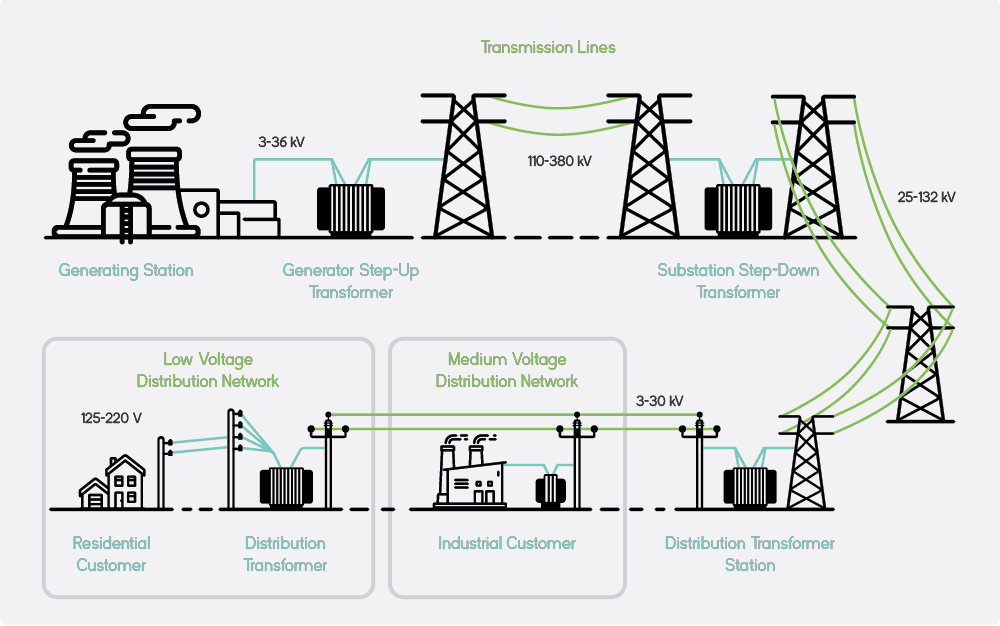
To minimize energy losses, electricity is transported through high-voltage transmission lines, typically ranging from 400 kV to 30 kV.
Substations then adjust the voltage levels depending on the stage of the grid.
The typical process is:
Generation at power plants
Step-up transformation to increase voltage for transmission
High-voltage transmission over long distances
Step-down transformation at substations
Medium-voltage distribution across cities and industrial areas
Low-voltage delivery to homes and businesses
This layered approach ensures efficient transport and safe use of electricity.
Transmission and Distribution Networks
Electrical grids operate at different voltage levels depending on their function.
High Voltage Transmission
High-voltage lines transport electricity across long distances, typically between 400 kV and 30 kV, reducing transmission losses and enabling large-scale power distribution.
Medium Voltage Distribution
Medium-voltage networks operate roughly between 30 kV and 1 kV, delivering electricity from substations to local distribution networks.
Low Voltage Networks
Finally, electricity reaches end users through low-voltage lines, usually below 1 kV, supplying homes and commercial buildings with typical voltages such as 220 V or 380 V.
Radial Grid Architecture
Many distribution networks use what is known as a radial grid structure.
In this architecture:
Electricity flows in one direction
Each consumer is connected through a single supply path
The distribution network branches out from substations
Radial systems are widely used because they are:
Simple to design
Cost-effective
Easy to operate
However, they may have lower redundancy compared to more complex network topologies.
European vs North American Electrical Distribution Models
Although electricity distribution principles are similar worldwide, two main distribution models dominate globally:
The North American model
The European model
Both rely on similar components, but differ in their network architecture and voltage distribution strategies.
North American Distribution System
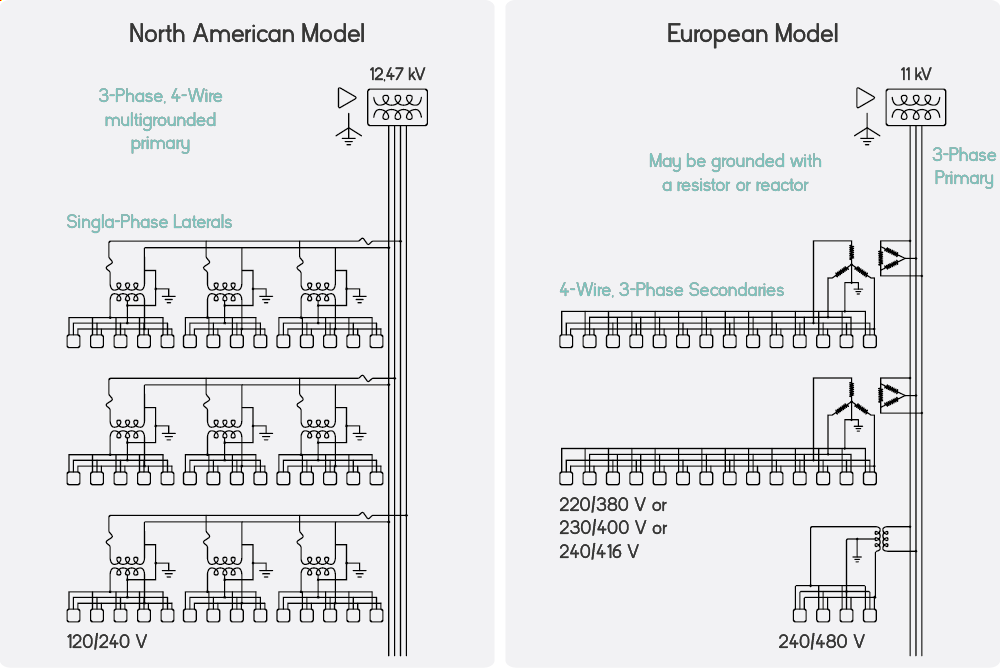
Typical North American distribution systems operate around 12.5 kV and usually follow a radial architecture.
Key characteristics include:
Three-phase, four-wire multigrounded primary
Single-phase lateral branches
Transformers stepping down to 120/240 V for residential use
Transformers are typically smaller (15–75 kVA) and serve a limited number of consumers within short distances.
European Distribution System
European distribution networks generally operate at 11–12 kV and use a three-phase primary system without neutral.
Key characteristics include:
Three-wire circuits
Delta-star transformer configuration
Secondary voltages such as 400/230 V
Transformers are usually larger, often 1000 kVA or more, and supply a much larger number of consumers compared to North American systems.
This approach allows European grids to distribute electricity efficiently across wider areas.
Key Differences Between European and North American Grids
Although the voltage differences between systems (roughly 120 V vs 230 V) may appear modest, the network structure leads to major differences in performance.
For example:
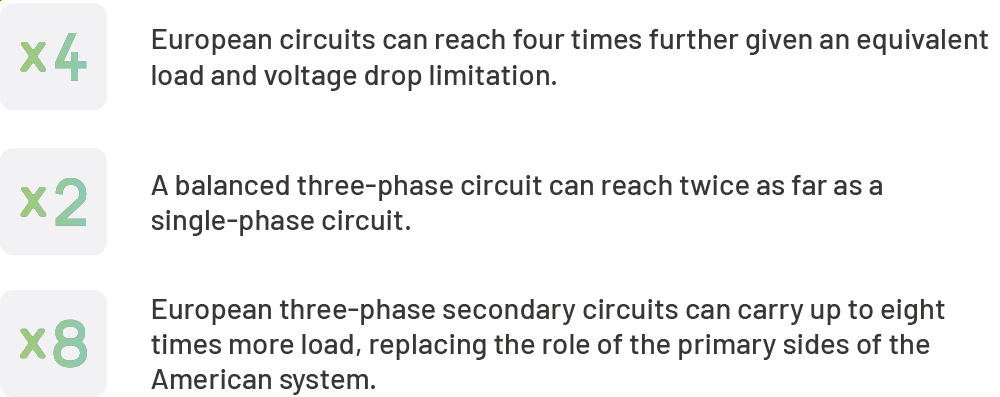
European circuits can reach four times further with equivalent load and voltage drop limitations.
Three-phase circuits can reach twice the distance of single-phase circuits.
European three-phase secondary circuits can carry up to eight times more load.
These differences influence how utilities design networks for urban or rural environments.
Mains Voltage Around the World
Electricity systems also vary by mains voltage standards, which differ by country.
Globally, two dominant voltage ranges exist:
100–127 V systems (common in North America and parts of Asia)
220–240 V systems (common in Europe, Africa, and many other regions)
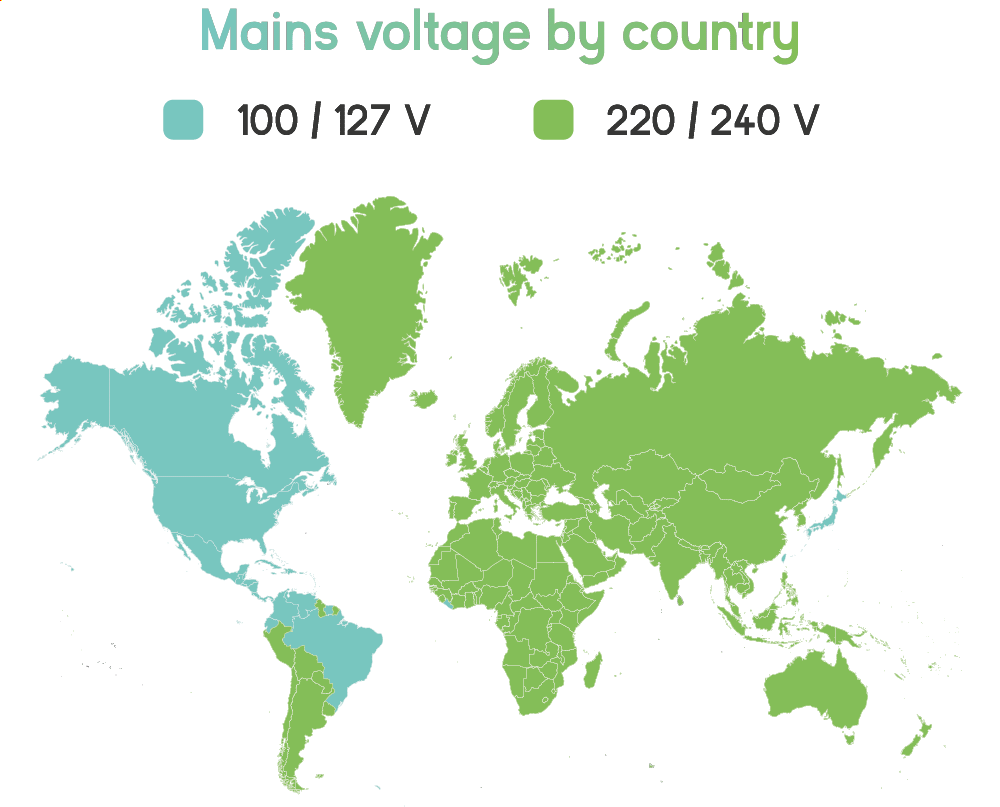
These voltage differences influence:
Electrical equipment design
Grid infrastructure
Development of grid simulation technologies.
Why Understanding Electrical Grids Matters
For engineers working in power electronics, energy systems and grid integration, understanding the architecture of electrical networks is essential.
Modern energy systems are evolving rapidly due to:
Renewable energy integration
Electrification of transport
Energy storage systems
Smart grids and digital monitoring
These trends require advanced power test solutions for grid applications capable of simulating real grid conditions in laboratory environments.
Conclusion
Electrical grids are among the most complex infrastructures ever built. While the basic principles of generation, transmission and distribution are shared worldwide, regional differences in architecture create unique challenges and opportunities.
Understanding these differences is essential not only for utilities but also for engineers designing the technologies that interact with the grid.
As the global energy transition accelerates, deeper knowledge of electrical grid structures will continue to play a critical role in building the next generation of power systems.
Sie können den gesamten Fall hier herunterladen
HERUNTERLADENWeitere Artikel
whitepapers
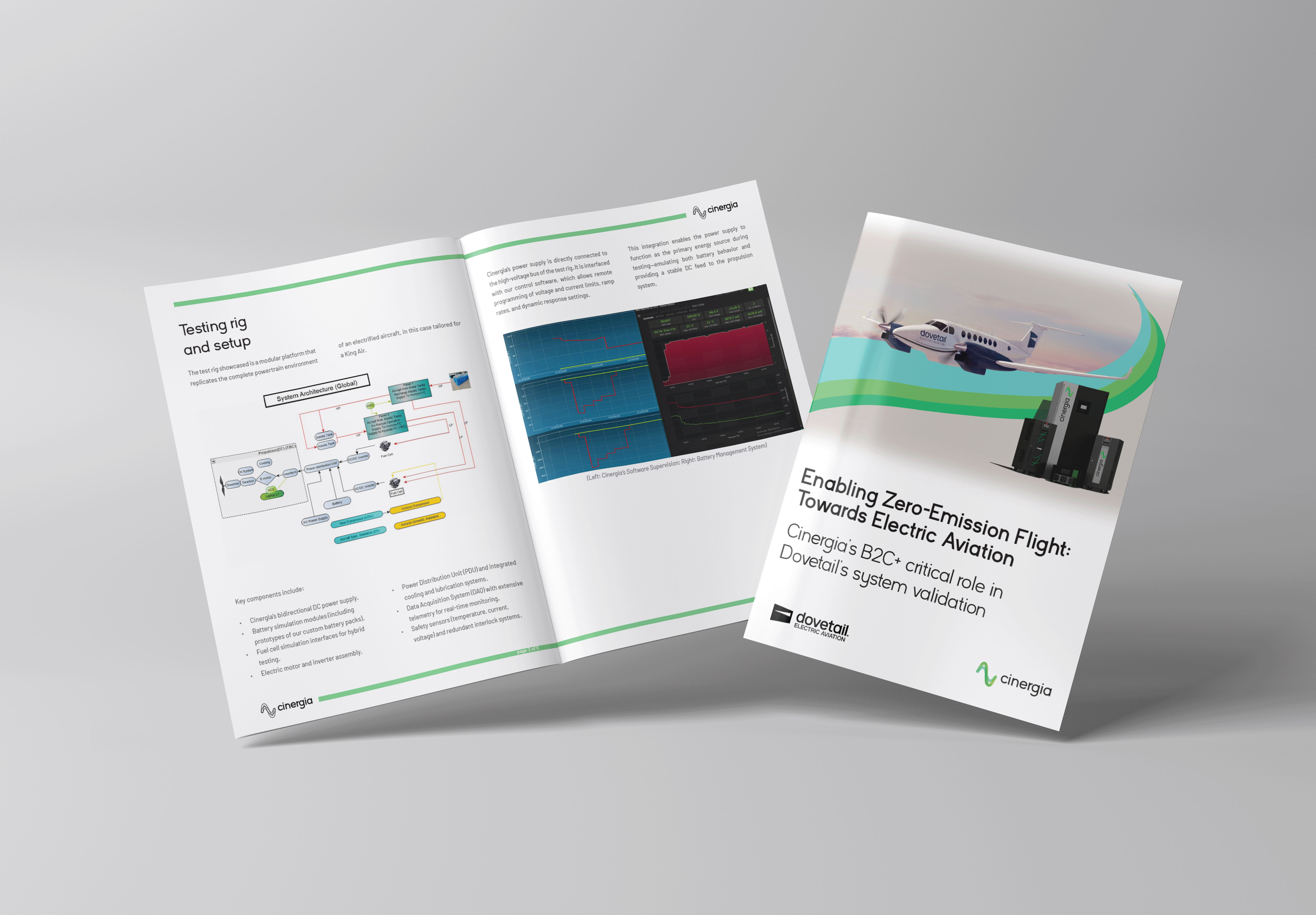
Enabling Zero-Emission Flight: Cinergia Powering the Future of Electric Aviation
Cinergia Power Solutions played a critical role in Dovetail Electric Aviation’s public demonstration of their hydrogen-hybrid electric propulsion system. Learn how our B2C+ regenerative power supply helped integrate and validate the entire drivetrain with precision and safety.
whitepapers
CINERGIA’s solutions for electromobility
CINERGIA has thorough experience in providing solutions for R&D, Functional and End of Line test in this field
whitepapers
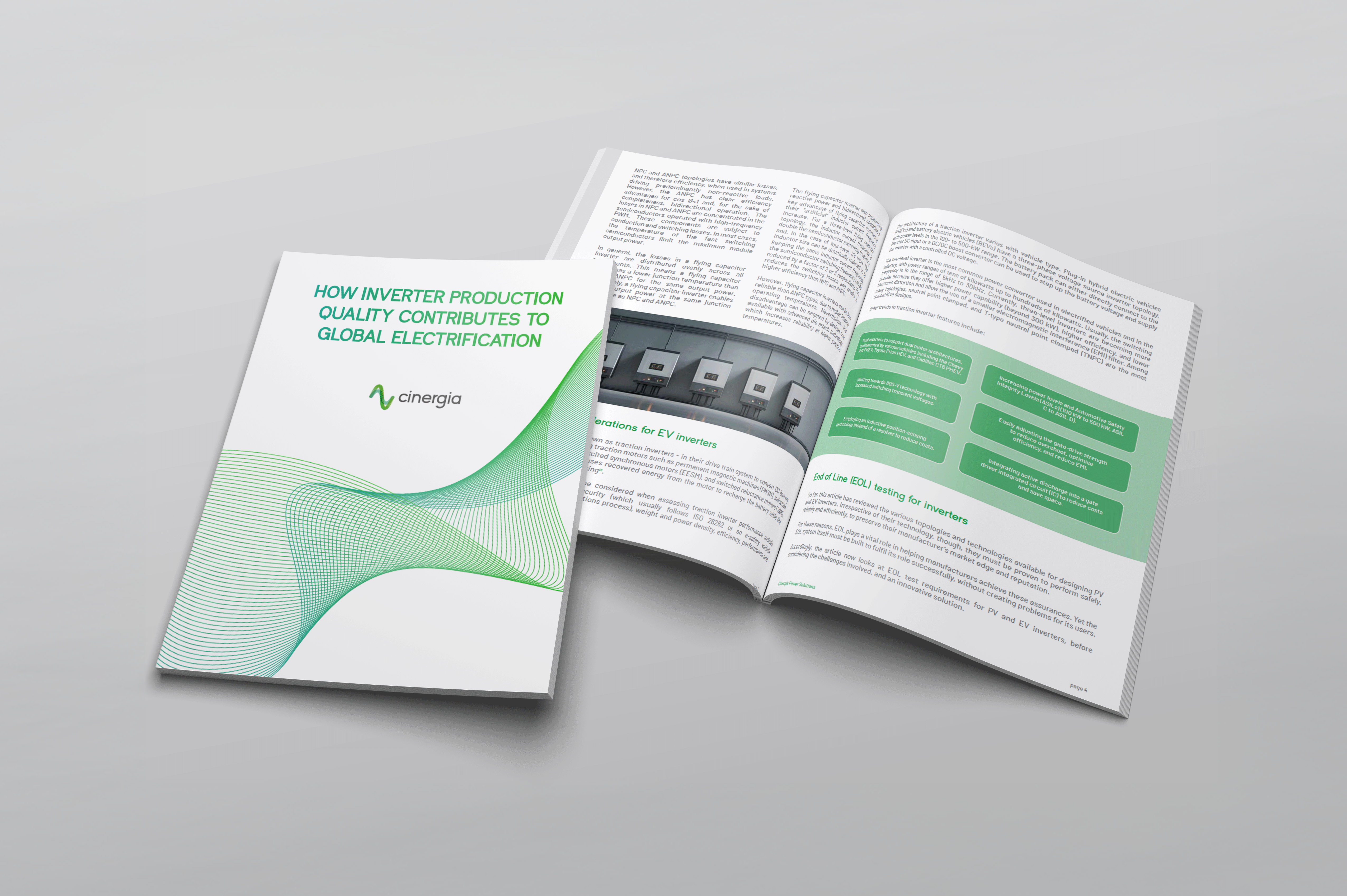
Redefining End-of-Line Testing: Efficiency and Precision with Cinergia Solutions
Discover how Cinergia Power Solutions brings flexibility, regeneration, and energy efficiency to End-of-Line testing for electric vehicles, batteries, and power electronics with a smart, cost-effective platform.
whitepapers
How to reap the benefits of Smart EV Charging safely and efficiently
Exploring the benefits and challenges of effective Smart EV Charging system deployment






Hilfe


©Cinergia 2026